How to protect balcony plants from frost (when “bring them all inside” isn't the answer)
A cold snap shows up in the forecast and the plan writes itself: move the pots inside. Except half of them don't need saving, one is too big to shift anyway, and the plant that actually dies overnight is the basil you walked straight past.
That is the trap with frost. “Bring them all in” treats every plant the same, and frost really doesn't. A few of your pots will shrug off a cold night. One or two are finished at the first proper freeze. The whole thing comes down to knowing which plant is which, and which ones are actually worth the trip to the hallway.
Why “just bring them inside” does not quite work
First, not every plant needs rescuing. Lettuce and rosemary shrug off a light frost. Basil and peppers are dead at the first proper cold night. Treating them all the same means you either panic over the tough ones or forget the tender one.
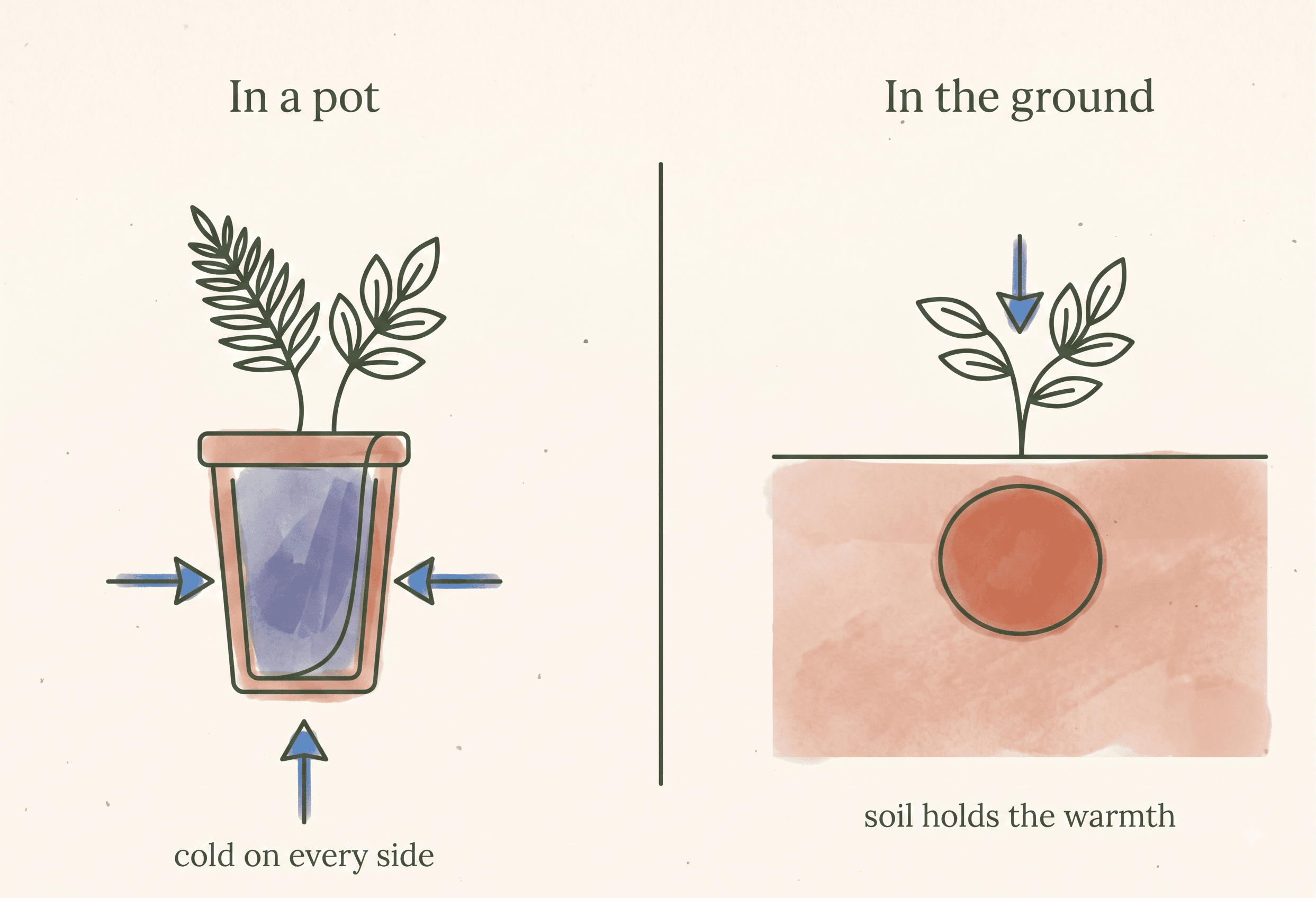
Second, and this is the part nobody tells you: a plant in a pot freezes faster than the same plant in the ground. In the ground, the soil wraps the roots and holds onto the day's warmth. A pot has cold air on every single side, so the root ball chills right through, and roots are less cold-hardy than the leaves above them. That is why a rosemary that would be fine planted in a garden can die in a pot on your balcony. It is not the plant being fragile. It is the pot being exposed.
Why the forecast does not tell you what happens on your balcony
The overnight low on your weather app is measured over open ground, a couple meters up. Your balcony didn't get the memo.
It can run colder than that number: an exposed container up on the 6th floor on a clear, still night, losing its heat to the open sky with nothing overhead to hold warmth in. Or it can run several degrees warmer: tucked against a heated building wall, under a balcony above, sheltered from the open sky. Same forecast, completely different night for your plants. The forecast low is a starting point, not an answer.
What actually decides whether they make it
Three things matter more than the headline temperature:
Which plants you have
Tender ones (basil, peppers, tomatoes, most summer flowers) go down at the first frost. Hardy ones (lettuce, parsley, rosemary) take a light one in stride. The single biggest factor, and it's per-plant.
How exposed the pots are
Cold concrete and the open railing pull heat from the root ball. A pot in the open loses far more warmth on a clear, still night than one against the wall. (For frost, wind is less of a problem than it looks: a breeze mixes warmer air back in.)
Where the wall and sky are
A clear night with open sky is when frost bites, because the pot radiates its heat straight up into nothing. A wall beside it or a balcony overhead changes that math.
None of these show up on a forecast. All three decide whether your basil is alive on Saturday.
Which of my balcony plants are frost-tender?
| Bring in or cover (frost-tender) | Can stay out (hardy to a light frost) |
|---|---|
| Basil | Rosemary |
| Peppers, tomatoes | Lettuce, parsley |
| Most summer flowers (geraniums, begonias) | Marigold |
| Most succulents | Olive (potted) |
A light frost is a night that dips a degree or two below freezing. A hard freeze is colder and lasts longer, and it pushes some of the right-hand column into “protect it too.” When you're not sure about your own balcony, check the plant, not the list.
Three fixes that work (and do not cost you anything)
- Move the tender pots against the building wall, or inside for the night. The wall is a free heater: it holds daytime warmth and blocks the open sky. For anything frost-tender, 30cm closer to the wall can be the whole difference. If it is going to be a hard freeze, the tender ones come inside, no argument.
- Cover overnight with an old sheet, fleece, or a cardboard box, then take it off in the morning. The cover traps the little bit of warmth rising off the pot and stops frost settling on the leaves. It needs to reach down over the pot, not just drape the top. And it comes off at sunrise, or you cook the plant you just saved.
- Group the pots together and lift them off the cold ground. Huddled pots shield each other's sides and hold heat better than one alone. A couple of bricks or a wooden board between the pot and freezing concrete stops the cold conducting straight up through the base.
What you do not need
You don't need to buy frost cloth. An old bedsheet or a cardboard box does the exact same job. You don't need to move every pot inside every single night all winter, that is the fast track to giving up. And you definitely don't need a greenhouse, a heat lamp, or anything you would have to screw into a wall you don't own. Frost protection on a balcony is mostly a sheet, a wall, and knowing which plant to bother with.
The part none of this tells you
None of this tells you which of YOUR plants are actually at risk tonight, on your specific balcony. That is what Balcony Plants does. Give it your location, which way your balcony faces, and what floor you are on, and instead of a generic “cover your plants” it gives you one line per plant: Basil, bring it in tonight, it won't survive this one. Rosemary, fine where it is, tuck it closer to the wall to be safe. Lettuce, leave it, a light frost won't touch it.
Plus a heads-up like this one the day before the cold lands:
Tonight your S-facing balcony in Reykjavik drops to around -2 to -1°C overnight.
In danger: Basil, Tomato
Do this tonight
- 1Tender. Bring it inside overnight; the first frost turns it black.
- 2A freeze ends it. Bring the pot in, or pick everything green tonight.
- 3Lift pots off the cold ground onto a board or a couple of bricks.
Tomorrow morning
Uncover by 08:39: move the pots back out once it climbs above freezing.
Tap the card above for the full per-plant verdict. The first check is free and takes under a minute.
Not sure what to grow there in the first place? Find the best plants for your balcony, free.
FAQs
How do I protect my balcony plants from frost or a cold snap tonight?
Move the tender ones (basil, peppers) against the wall or inside, cover what stays out with a sheet or cardboard box, and lift pots off the cold ground. You don't have to do all three for every plant. Match the effort to which plants are actually frost-tender.
Do I need to bring all my potted plants inside for frost, or just some?
Usually just some. Hardy plants like lettuce, parsley, and rosemary handle a light frost outside. It's the tender ones (basil, peppers, tomatoes, most summer flowers) that need to come in or get covered. Bringing everything in every night is more work than it's worth and hard to keep up.
Does covering plants actually protect them from frost, and what do I cover them with?
Yes, and an old sheet, fleece, or a cardboard box works as well as anything you'd buy. The cover traps the small amount of warmth rising off the pot and keeps frost from settling on the leaves. Two rules: it has to drape down over the pot, not just sit on top, and it comes off in the morning so the plant gets light and doesn't overheat. And cover earlier than you'd think: in our 12-city frost study, covering when the forecast low hit 4°C (39°F) caught 99% of balcony-pot frost nights, against 69% for the usual 0°C (32°F) rule.
How cold is too cold for my potted plants?
It depends on the plant, and on where the pot sits. Tender ones start taking damage a few degrees above freezing and die at a proper frost; hardy ones handle a light frost fine. For a pot on a balcony railing, our 12-city frost study found a safer general rule: cover when the forecast low is 4°C (39°F) or below on a clear, still night. We work out which of your plants it applies to, plant by plant.
Why do potted plants get frost-damaged when the same plant in the ground is fine?
Because the pot is exposed on every side. In the ground, soil insulates the roots and holds the day's warmth; in a pot, cold air surrounds the whole root ball and it chills right through. Roots are also less cold-hardy than the leaves, so the damage often starts below the soil before the top of the plant shows it.
Does my balcony's position, which floor and whether it's against the wall or out in the open, change the frost risk?
A lot. A pot tucked against a heated wall or under the balcony above stays warmer than one out on an open railing under open sky. A clear, still night with open sky above the pot is the worst case, while a breeze or cloud cover cancels most of that extra chill. The floor matters less than you'd think: a high balcony misses the cold air that pools near the ground, but it sees more open sky. Two balconies with the same forecast can have very different real risk.
How do I tell if it's frost damage or something else, like overwatering or normal winter dieback?
Timing and pattern. Frost damage shows up suddenly, a day or two after a cold night, and hits the most exposed, sky-facing parts all at once. Overwatering is gradual: lower leaves yellow, the soil stays wet, and there's no cold night behind it. Normal winter dieback on a hardy plant is slow and expected, and the stems underneath are still alive. If it went limp and dark right after a cold snap, it's the frost.
What does frost damage actually look like on a potted plant?
The leaves go dark, limp, and water-soaked looking first, then dry out papery and brown over the next day or two. Soft new growth turns to mush. It's usually worst on the side facing the open sky. The catch is it often looks fine the morning after and only shows the damage a day later, once the tissue has collapsed.
Will covering my pots even work on a high, open balcony where it's windy and there's nothing overhead?
It still helps, but the wind is the catch. A cover works by trapping the thin layer of warm air rising off the pot, and an open, gusty balcony keeps stripping that away, so you get less out of it than a sheltered garden would. Two things you can actually do up here: move the tender pots back against the wall or into a corner before you cover them, and weigh the cover down at every edge (books, bricks, clips) so it's not on next door's balcony by dawn. A pot tucked against the building and covered rides out a light frost far better than one left on the open railing.
What can I do about frost if I can't bring my balcony plants inside, and have no garden, garage, or shed?
You've still got real options, none of which need more than a balcony. Group the tender pots together against the warmest wall (the one the building heats from inside), lift them off the cold floor onto a stool, an upturned crate, even a folded towel so the roots aren't sitting on freezing concrete, and drape a sheet or fleece over the huddle for the night. Clustering does more than it sounds like: the pots shield each other, and a tight group holds warmth far better than the same plants spread out along the railing.
Should I bring my balcony herbs, peppers, and tomatoes in before the first frost?
Most of them, yes, and they're usually the first things a frost takes. Basil is the giveaway: it goes black at temperatures still a few degrees above an actual frost, so it comes in first. Peppers and tomatoes won't die in a light chill, but they stop ripening and the fruit turns sad, so if you want to finish the last crop, move them to the warmest spot or inside on the cold nights. The hardy edibles are the opposite: lettuce, parsley, and rosemary shrug off a light frost, so those can stay out.
How do I know when the first frost is actually coming for my balcony, not just the general area?
The public forecast is your starting point, but it's measured in a field or at the airport, not on your balcony, and the two can differ by a few degrees. A pot against a warm wall might be fine on a night the forecast calls frost; one on an open, high railing under a clear sky can get colder than the number you're given. What you actually want is a day or two of warning for the tender plants specifically, so you're not hauling pots in at midnight or finding the basil gone black by morning. That per-balcony, per-plant read the night before a cold snap is exactly what the checker does.
One thing to actually do tonight
If there is a frost or a cold snap in your forecast this week, don't drag every pot inside and hope. Find out which plants are actually at risk and move the two that matter.